Finding 01
Users rely on memory to compare listings.
Because listings are viewed one at a time, users often switch back and forth between properties and mentally track differences like rent, commute, amenities, and safety.
Case study / 02
Timeline
March 14 – May 4, 2026
Role
Lead Product Designer
UX Researcher
Team
Victoria Hong (myself)
Briana Grant
Han Lee
Process
Needfinding (User Survey, Participant Observation, Heuristic Observation, Think-Aloud Studies, Product Review Analysis)
Individual & Group Brainstorming
Lo-Fi (Paper & Pencil Sketches), Mid-Fi & High-Fi Prototyping (Figma)
Evaluation

Final concept preview showing a collaborative apartment search experience for roommate groups.
Overview
Finding rental housing with roommates is a collaborative but fragmented process. While Zillow provides extensive property listings, the current experience primarily supports individual browsing and evaluation. Roommates still have to manually share links, track tradeoffs, compare listings, and align on preferences outside the product.
Our project explored a roommate-focused rental comparison feature for Zillow’s mobile interface. The goal was to help users save listings, compare properties side-by-side, evaluate shared criteria, and reduce the cognitive effort involved in choosing housing as a group.
Problem overview
Zillow makes it easy to browse rental listings, but it does not fully support the collaborative work that happens after users find options. Roommates often share links through group chats, revisit multiple listings, compare attributes from memory, and use external tools like screenshots, notes, or spreadsheets to track tradeoffs.
How might we
Research methods
To explore our problem space, we asked questions based on our understanding of
our primary target audience, the key stages of collaborative rental search workflows,
and their pain points.
Over the course of a month, we applied a mixed-method approach of qualitiative
and quantitative research to investigate our questions. We used survey research to gather
an understanding of the problem space and audience, participant observation to
study how users use Zillow for their search through apprenticeship, and think-aloud studies
to gain further insight on what actually happens during comparison, sharing, and decision-making.
Collected rental search behaviors, demographic, tracking methods, and collaboration pain points.
Questions ResultsParticipated in the mobile workflow of browsing, sharing, and comparing Zillow listings.
ResultsCaptured how users reasoned through tradeoffs while comparing rental options.
Guide ResultsTranslated findings into needfinding insights and design opportunities.
Research findings
Across our research, users compensated for missing collaborative tools by relying on memory, screenshots, group chats, saved links, notes, and spreadsheets. These workarounds helped users keep moving, but they also increased friction and made it harder to reach confident decisions.
Because listings are viewed one at a time, users often switch back and forth between properties and mentally track differences like rent, commute, amenities, and safety.
Users share listings through group chats, shared documents, spreadsheets,
and in-person discussion, causing links to become buried and preferences
difficult to track.
60% of participants reported losing track of a listing during comparison,
indicating that collaborative workflows are disorganized and spread across
multiple platforms.
Users reported that making the final decision and aligning roommate preferences were the most stressful part of the process. Because users compare multiple criteria and rely on consensus, coordinating preferences across roommates increases decision complexity.
Ideation
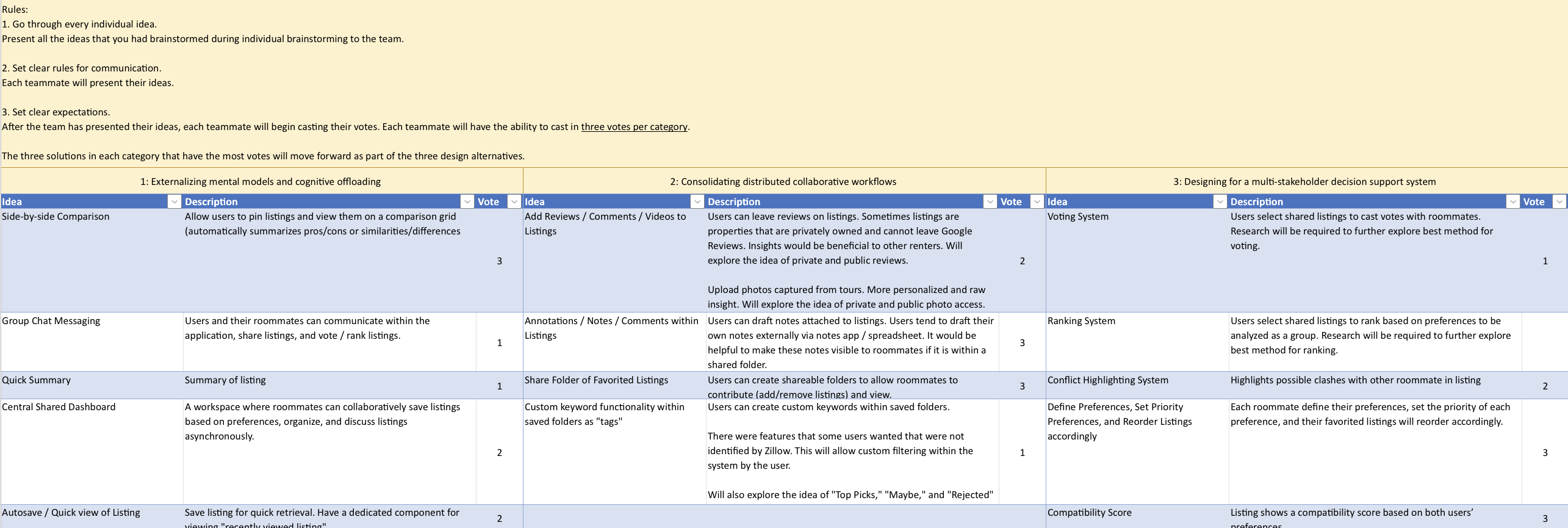
Our brainstorming focused on reducing cognitive load, addressing user workarounds,
and treating roommates as multiple stakeholders with constraints that need to be
reconciled.
We generated up to 10 concepts individually for approximately 20 minutes,
converged as a group, and selected three design alternatives for initial prototyping.
Design alternatives
Each design alternative addressed a different part of the collaborative search problem: comparison, shared organization, and decision support.
A combined experience with shared folders, preference setting, compatibility scores, comments, and conflict highlighting to make alignment and disagreement more visible.
A shared folder that organizes favorited listings by compatibility score, helping roommates quickly identify which options best align with group preferences.
A structured comparison chart that helps users view listings together, compare attributes, add notes, and reduce the need to mentally track differences across properties.
Evaluation
We evaluated the mid-fidelity prototypes through semi-structured user interviews and comparative tasks. Participants interacted with the design alternatives and provided quantitative ratings and qualitative feedback on clarity, ease of use, cognitive offloading, and collaborative decision support.
Rated highly for clarity and reducing the burden of memorization.
Viewed as intuitive and useful for centralizing group decisions.
Helped users make faster decisions by aggregating preferences into one metric.
Removed lower-value features and merged the strongest concepts into one system.
Final solution
The final high-fidelity prototype integrates four core features: Shared Folder, Side-by-Side Comparison Chart, Compatibility Score & Insights, and Renter Preferences. Together, these features help roommates externalize information, reduce memory burden, and make more transparent housing decisions.
A centralized shared space where roommates can save and access the same set of listings, reducing the need to send links across group chats.
Users can compare selected listings across rent, bedrooms, bathrooms, availability, square footage, amenities, parking, safety, and neighborhood factors without switching between pages.
The system evaluates saved listings against each roommate’s preferences and provides a score, criteria breakdown, and explanation to support faster group decision-making.
Each roommate can define constraints such as budget, bedroom and bathroom count, parking, amenities, and safety preferences. These inputs power the comparison chart, dashboard, and compatibility insights.
Final evaluation results
In the final evaluation, participants rated all four core features highly. Shared Folder received the highest overall ratings, followed closely by Side-by-Side Comparison and Compatibility Score & Insights. Participants especially valued features that reduced mental tracking and made group preferences visible.
The evaluation also revealed an opportunity for improvement: users relied on Compatibility Score & Insights, but wanted clearer explanations of how the score was calculated.
My role
As a UX researcher and product designer, I played a leading role across the project’s research, design, and evaluation phases. I conducted participant observation, developed structured materials for the think-aloud study, synthesized needfinding insights, created personas and task flows, and shaped the team’s brainstorming process. I also designed and evaluated the side-by-side comparison concept, refined the high-fidelity prototype, and helped execute the final usability evaluation to validate how the redesigned Zillow experience supported collaborative decision-making.
Reflection